











We have much more to do and your continued support is needed now more than ever.
October is Bat Appreciation Month!
Learn bat facts and test your bat knowledge with our quiz!
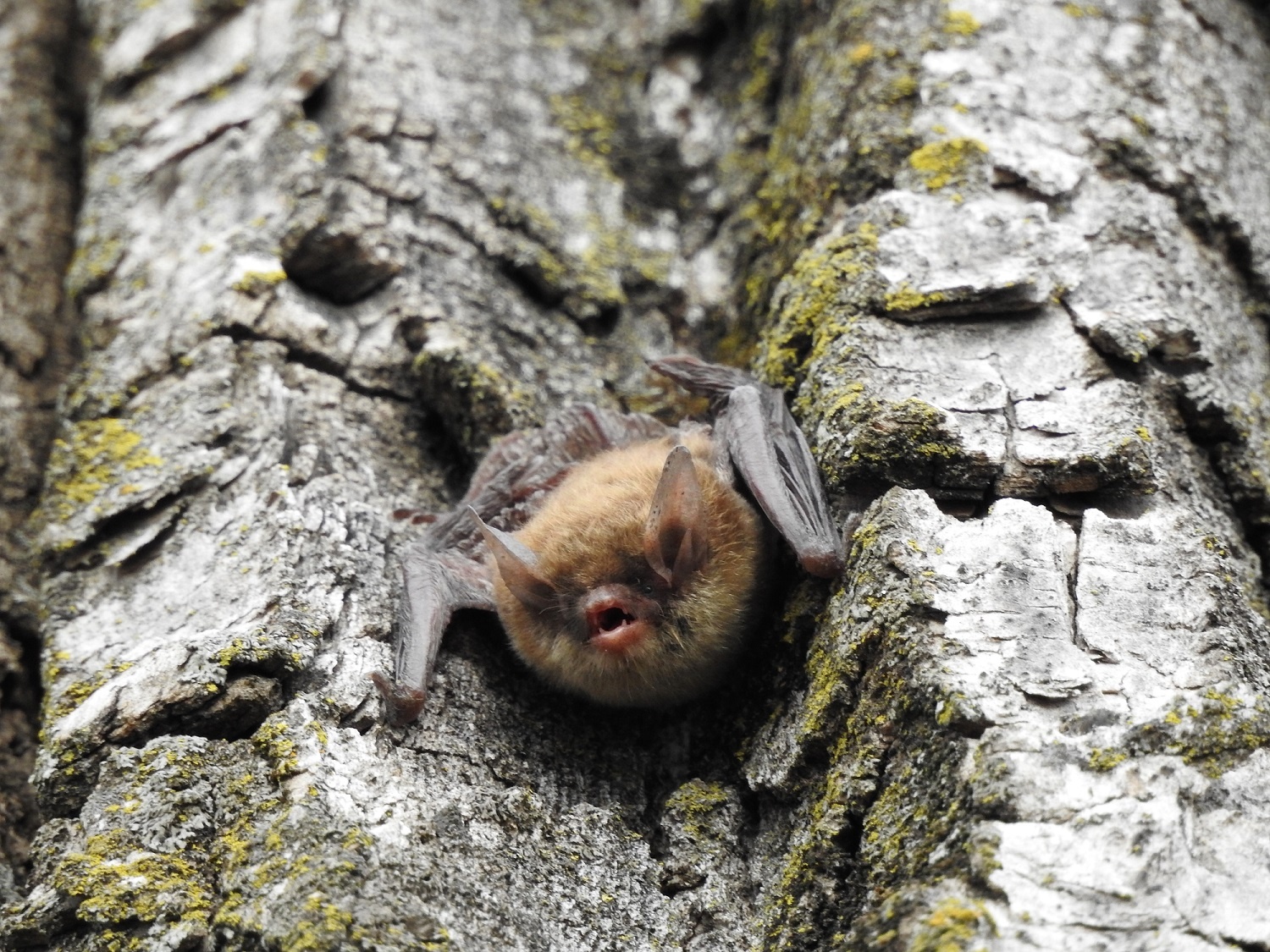
Northern long-eared bat. Credit: Brad Mears
Right off the bat, I’m compelled to share that my love of bats likely exceeds your average animal lover. I find their adorable, fuzzy bodies and the only mammal capable of true flight, fascinating. However, when I host tabling events or visit classrooms to discuss the myriad critters among Montana’s landscapes, bats are among the most asked, misunderstood, and sadly feared.
It’s not just the cuteness-overload drawing me to bats, but the variety within species and the role they play around the world. There are over 1,400 bat species worldwide, with 47 found in the United States and Canada. These remarkable fliers not only consume vast numbers of mosquitoes but also pollinate night-blooming flowers, making them enchanting and essential to healthy ecosystems.
Despite their contributions to a comfortable evening, their populations are at extreme risk. According to the U.S. Fish and Wildlife Service, there are ten endangered bat species in the U.S. and its territories. The North American Bat Conservation Alliance published a “State of the Bats” report in 2023, showing “52 percent of bat species in North America are at risk of populations declining severely in the next 15 years”. Endangered species can only recover with the help of humans. Here are a few of the species endangered in the U.S.:
- Northern long-eared bat (Myotis septentrionalis)
- Ozark big-eared bat (Corynorhinus (=Plecotus) townsendii ingens)
- Florida bonneted bat (Eumops floridanus)
Why are bats important to the environment?
- Pest Control. Bats aren’t just skilled at creating detailed acoustic maps of their surroundings; they’re also nature’s pest control. It’s estimated bats provide a natural pest control to reduce crop damage and the cost of pesticides by over $1 billion each year.
- Pollination. Many bats are fruit or nectar-eating bats, which means as they fly from plant to plant, they’re pollinating those plants too. Bats not only maintain a healthy biodiverse ecosystem but contribute to our food supply.
- Seed Dispersal. When bats eat fruit, they in turn disperse the seeds further, adding to our ecosystem’s biodiversity and helping regenerate forests.
- Nutrient Cycling. In delicate cave ecosystems, bat scat, or guano, provides nutrients upon which other cave-dwelling creatures rely.
Color outside the bat cave! Download NWF’s bat coloring pages and choose your favorite bat to color or color them all.

Bat Survival
- But how do bats use echolocation? Bats emit high-pitched sounds that bounce off objects. When the sound returns, echoes off their enormous ears and pinpoints objects, allowing them to navigate their environment. Echolocation has been studied to aid in the development of airport machines and military sonar, a concept known as biomimicry. Other examples of biomimicry are Velcro, gecko’s grip, and spider’s silk. You can learn more about the Townsend’s big-eared bat, and other wildlife in the National Wildlife Federation’s Wildlife Guide.
- What do bats eat? Bats in the U.S. are mostly insectivores, meaning they eat insects, while the rest are frugivores and nectivores, or fruit-eating and nectar-eating, respectively. The frugivore and nectarivore bats’ feeding behavior means they are pollinators and play a critical role in our ecosystems.
- Where do bats sleep during the day? A bat house provides a safe place for bats to roost, or rest, during the day. Some bat species hibernate, a long period of inactivity without feeding or drinking, while some migrate instead. Depending on the species, roosting sites can include caves, bat houses, under tree bark, house siding, attics, under bridges, and more. These roosts are essential for resting, raising young, and protection. Visit here to build a bat house to hang at home, school, or business. Better yet, watch Roanoke College’s video on the ins and outs of building and installing a bat box, funded by Mutual of Omaha’s Wild Kingdom College and University Grant Program.
Help expand bat habitat! View our bat tip sheet and learn how to create bat habitat or build a bat house in your own backyard.

Think you’re ready to step up to bat and test your knowledge? Take our bat quiz!
How can you help?
Whenever I see the erratic flight of our nocturnal friendly fliers, I pause to appreciate the moment. Because while these threats are serious, there are practical steps you can take to help bats. When we help bats, we help our ecosystems. Here are some simple ways you can help in your backyard or in your community:
- Plant Native. One of the best ways to create habitat for wildlife is to install native plants.
- Build A Bat Box. Install a bat box in your yard to provide safe roosting space for endangered species, including the Northern long-eared bat, and other local bats. You can access tips, tools, and videos to help turn your outdoor space into a wildlife-friendly habitat. Watch a how-to video created by Roanoke College students for step-by-step guidance.
- Leave The Leaves. This fall, leave the leaves in your yard to provide winter shelter for several bat species.
- Turn Off Unnecessary Lights. Keep your yard darker to support bats, using red lights if illumination is needed, or better yet, minimize outdoor lighting altogether.
- Avoid Using Harmful Chemicals. Pesticides and fertilizers harm bats and other wildlife. Homeowners use up to 10 times more chemical pesticides per acre on their lawns than farmers use on crops.
- Be A Voice for Wildlife. No matter how big or small we think we are, when we speak up together, our voices can have a huge impact! It can be as simple as talking to friends and family, writing letters, and sharing your voice on social media.
- Support the Recovering America’s Wildlife Act. Encourage your Congressional representatives to fully support and help pass the Recovering America’s Wildlife Act. This historic wildlife legislation offers the best hope for addressing the nation’s wildlife crisis.
Read NWF blog about Bats and Halloween here!

Kids’ Corner
- Download bat coloring pages with fun facts!
- Find out how to look for bats!
- Read: 5 uses for bat wings
- Read: Batty for Flying Foxes
- Watch: How does a bat sleep?
- Activity: Make a bat tree for Halloween
- Activity: Make a bat finger puppet
- Adopt! Symbolically Adopt an Animal – Big Brown Bat
Educator’s Call to Action
Bats, as the only flying mammals, are misunderstood and vital to our ecosystems. Engaging students in discussions about bats, the threats they face, and the actions they can take at home provides hands-on learning opportunities, sparking curiosity across science, ecology, conservation, and even history.
Educators can explore topics such as:
- Food webs & ecosystems
- Nocturnal vs. diurnal animals
- True flight
- Echolocation
- Biodiversity
- Conservation challenges
- Bats and Halloween

Building Momentum: What’s Next for Beaver Conservation in Colorado