











We have much more to do and your continued support is needed now more than ever.
Defunding the Future: Inside Federal Cuts to Tribal Energy Sovereignty
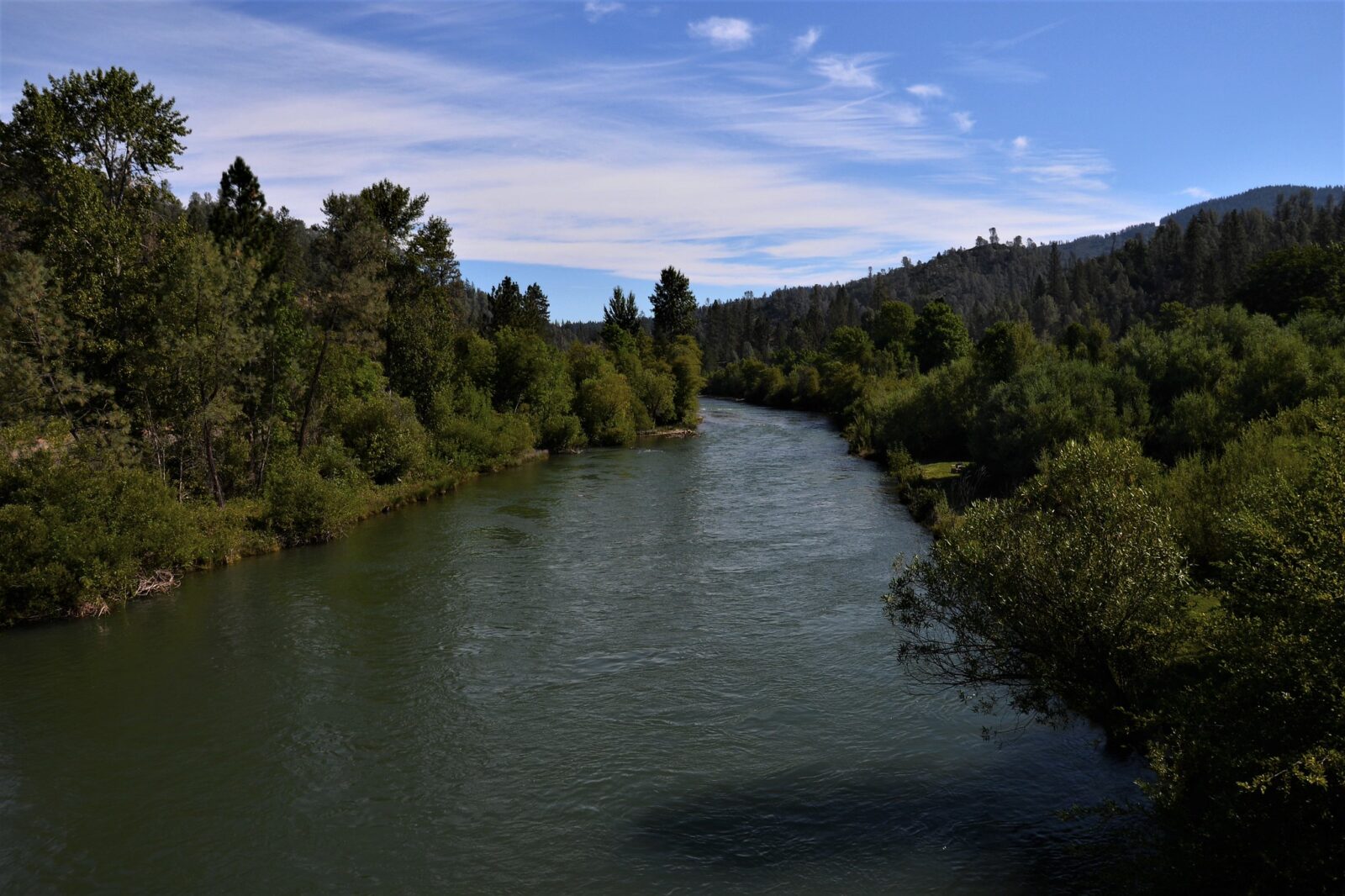
The original Hupa name for the Trinity River was the Hoopah River. Credit: Bureau of Reclamation/Flickr
In the far north of California, the Hoopa Valley Tribe is tucked among steep forested mountains and the winding Trinity River. This land has been home to the Hoopa for millenia. As General Manager of the Hoopa Valley Public Utilities District (HVPUD), Linnea Jackson’s work revolves around the essentials that sustain the community—water, solid waste, broadband, and energy. These are not just services, they are the imperative for sovereignty and survival.
For more than four decades, HVPUD has worked to build and maintain critical infrastructure for their Tribal community in one of the most remote regions of the state. But they are faced with a persistent reality—that the community is within one of the least reliable electrical circuits in Pacific Gas and Electric’s (PG&E) territory.
In fact, Hoopa consistently appears among the top circuits with the most outages and as well as the longest outage durations in PG&E’s annual reliability report. Despite this, there’s no mechanism that forces investment into those repeatedly failing circuits. The result is an ongoing cycle of neglect that leaves Tribal members vulnerable, especially during extreme weather like winter storms.
A Vision for Tribal Energy Sovereignty
To change this, HVPUD joined with the neighboring Yurok, Karuk, and Blue Lake Rancheria Tribes and regional partners Redwood Coast Energy Authority, Schatz Energy Research Center, and PG&E to advance the Tribal Energy Resilience and Sovereignty (TERAS) project. This project is a multi-Tribe plan to bring clean, reliable, and affordable energy to the region using microgrids.
The project was conditionally awarded $87 million in January 2025 through the Department of Energy’s (DOE) Grid Resilience Innovations Program. The funding was intended to build a network of Tribally-owned and operated microgrids that would address the persistent power reliability issues across Northern California’s rural and mountainous region.
Additionally, the team secured partnerships, technical support, and matching funds. For what would have been a $220 million project, they assembled over $100 million in non-federal matches through state grants, tax credits, and philanthropic sources. That kind of financial alignment is rare, especially for Tribes, and it took years of perseverance and trust-building to achieve.
Whiplash
In October 2025, word spread that the federal government had quietly withdrawn over 300 awards including the TERAS project grant.
For nearly a year, HVPUD had been working under the assumption that funding was imminent (not including the several years of planning this project with partners). They had invested countless hours planning, legal review, designing, and meeting with engineers, partners, and Tribal Councils. Then, without notice or explanation, TERAS was put on the most recent list of cancelled DOE awardees totaling $7.5 billion in cuts.
To Linnea, this felt deeply personal. The team had proven the concept and met every technical and policy benchmark. Linnea explained, “to have the project dismissed so casually felt like a betrayal of the effort and integrity of everyone involved.”

The Human Cost of Unreliable Power
When the power goes out in Hoopa, it’s not just a brief inconvenience, it can turn into a crisis. Outages can last from hours to weeks. For elders and residents with medical needs, like at-home dialysis, these outages can be life-threatening. They also threaten the operation of two water treatment plants and twenty water storage tanks, as well as the broadband towers—leaving many without access to critical communication sources.
The temporary solution involves using diesel generators. Residents often have their own while PG&E will bring in larger backups. Although they temporarily restore power, they also bring noise, pollution, and a dependence on fossil fuels—which contradicts TERAS’ long-term goal of clean, sustainable energy.
Building a Clean Energy Future
The TERAS project would have changed that. The plan uses seven megawatts of solar generation per year with small-scale hydroelectric to supplement during low-sunlight months. With Hoopa Valley only using an average of three to four megawatts per year, the battery storage included in the project would provide a surplus and ensure reliable energy during emergencies.
Even as the TERAS team regroups amidst the grant cancellation, smaller projects are hopeful to continue, like California Energy Commission’s grant for long-duration energy storage and PG&E’s Community Microgrid Incentive Program. Hoopa Valley engineers must now redesign a scaled-down, modular version of the project that keeps the vision alive while they seek new funding.
Resilience in Action
The setback has forced the team to think differently and act accordingly by exploring new partnerships beyond the federal system. The TERAS collaboration has already proven that Tribes can lead large-scale, technically complex, intergovernmental energy projects. Even in uncertainty, their commitment has not wavered.
“This isn’t just about kilowatts or infrastructure—it’s about sovereignty, dignity, and climate resilience. Our goal is to build systems that serve our people, powered by our values, and that is resilient in the face of both natural and political storms,” said Linnea. The Hoopa Valley has always been self-reliant. This setback may have shaken things, but it won’t stop progress. “We’ll continue building—phase by phase, project by project—until every light that goes out in our valley can be turned back on by our own hands.”
