




We have much more to do and your continued support is needed now more than ever.
An iconic orca calf has arrived. And it needs more to eat
Let’s grab the opportunity to save a living national treasure
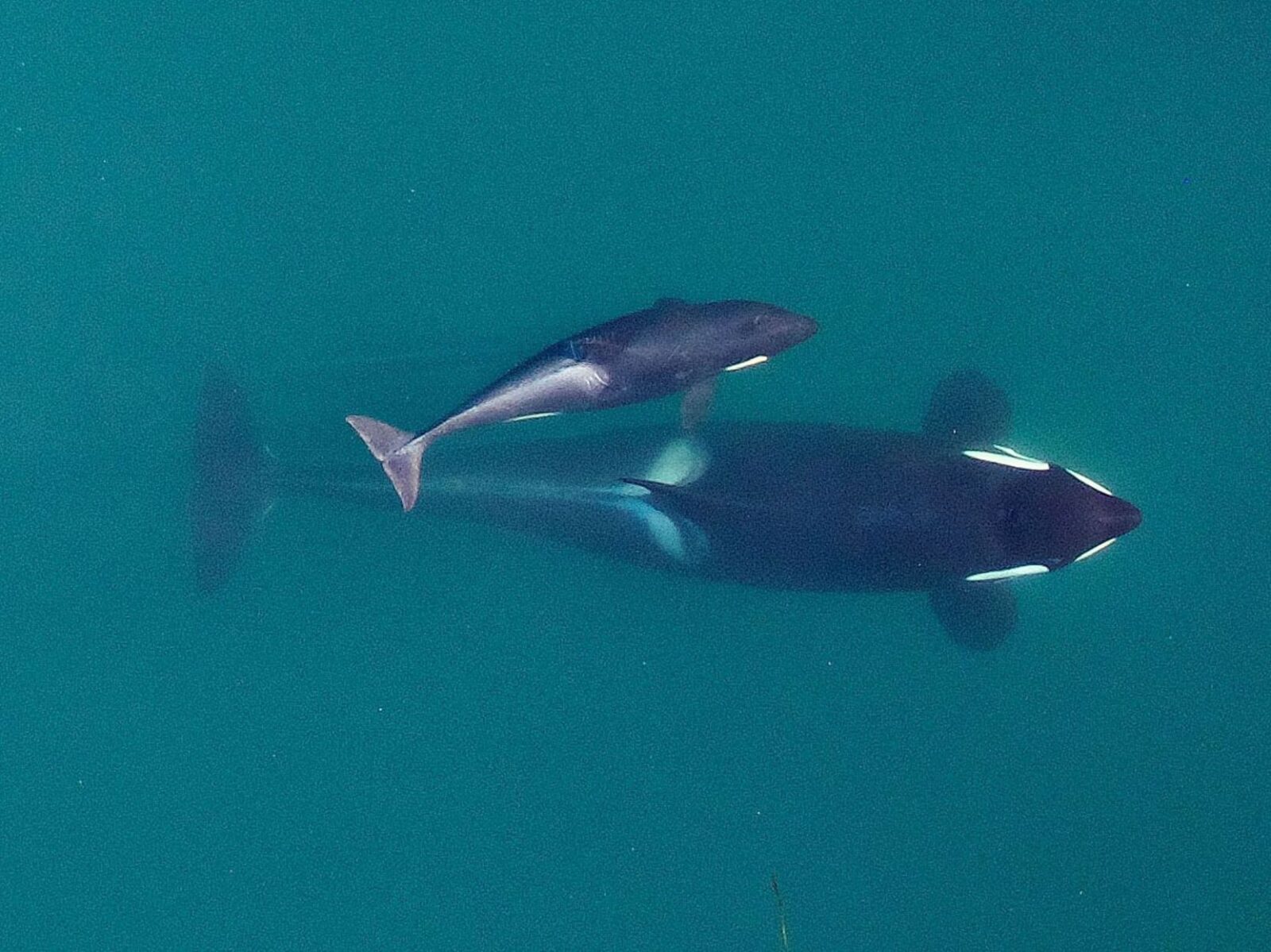
Adult female Southern Resident killer whale J-16 swimming with her calf. Credit: NOAA Fisheries
It’s summer in the Pacific Northwest, and with it comes news of the arrival of a Southern Resident orca calf. Each time, we greet this news with joy, yet prepare for heartache.
This round is no different: New southern resident orca calf spotted as another vanishes.
The photo accompanying the June news story of a newborn orca L130 is encouraging. Little L130 is surfacing, swimming, bouncing, alive—and most importantly, “appearing well-fed, with visible fat reserves.” This fills us all with hope.
Though a new calf is here, this latest dispatch comes from the frontline of extinction. We hold our collective breath and hope for this newest addition to the L Pod because the Southern Resident orca are an emblem of an endangered species. This specific population of orca whale was once 200 strong, but has dwindled to just 74, pushing them ever closer to extinction.
Our evolving relationship with marine mammals
I was visiting my old home near Penn Cove, when the news of L130 landed. It’s a bizarre coincidence given that this is the site of a deeply tragic chapter in our relationship with these magnificent Salish Sea denizens. From these tranquil waters, between 1965 and 1973, 45 Southern Resident killer whales were penned, captured and then delivered to marine parks. Tokitae, also known as Lolita, was among the whales airlifted out of Penn Cove and ultimately sold to the Miami Seaquarium.
Tokitae became known worldwide and was the last orca in captivity when she died in 2023. It was her plight that prompted an important evolution in our relationship with these whales and the ethical treatment of them. In 1976, a federal court settlement permanently prohibited the capturing or selling whales from Washington waters. It was an important moment in public opinion that finally rejected the idea of the trafficking of these intelligent whales in service of cheap entertainment.
As Tokitae’s strange life unfolded at the Miami Seaquarium, so did that of the members of J, K L and L pods in her orca family. However, their fight to thrive was shaped by an entirely different force: the pursuit of cheap hydroelectric energy in the Northwest.
Salmon runs hit a wall in the era of cheap hydroelectric energy
After the construction was completed on the Lower Granite dam in 1975, the fourth on the lower Snake River, fish migration and populations began to suffer. As a result, the Southern Residents, who thrived on Columbia River Basin chinook, began to feel the sting of misguided river management. It was depriving them of their most important food source.
The impacts to salmon and steelhead populations quickly accumulated when migration routes were blocked and the fast-flowing river was transformed into a series of slack pools of increasingly hot water, fatal to cold-water fish. Climate change accelerated river temperatures and fish kills. Soon—and to this day—the plight of the Southern Resident orca is largely defined by starvation.
In 2018 and again in 2025, it was the orca mother Talequah pushing her dead calves that focused international attention on the many challenges that these magnificent sea mammals face. Top among them is hunger. If we can put a stop to the cruelty of capture and captivity of orcas, couldn’t we also commit to ensuring that they have enough to eat? Dams are replaceable. Salmon are not. Once dams come out, as we’ve seen repeatedly across the country, and most recently on the Klamath, fish populations recover.
A historic visit and a lesson to be learned
In the fall of 2024, the members of the L pod returned to Penn Cove for the first time in 53 years. Observers saw the whales “pacing,” and “swimming back and forth, near three different sites that were important to the captures.” The orcas’ behavior was deeply moving to residents of the Cove.
As a former resident myself, I’m wondering if the room for healing puts a more important and urgent call for the need to do better for these beautiful mammals. We know this orca mother wants her little calf to thrive. We know they are struggling. We know that they need more food to eat.
