







We have much more to do and your continued support is needed now more than ever.
Happy Manatee Appreciation Day!

A manatee says hi to the camera. Credit: Sarah Echo
Manatees have always held a special place in my heart. My love for these mammals started when my elementary school teacher and I adopted one through Save the Manatee Club when I was eight years old. Now I watch them in the wild at Shoreline Park in Gulf Breeze, FL, just minutes from my home, and it never ceases to amaze me.
What are Manatees?
The coastal waters of Florida are the permanent home of the Florida Manatee (Trichechus manatus latirostris), a subspecies of the West Indian manatee, a year-round resident. These “gentle giants” are primarily found in shallow, slow-moving rivers, estuaries and coastal bays where they can easily access their primary food source, seagrass. Adult manatees are typically 9-10 feet long from snout to tail and weigh around 1,000 pounds; however, some may grow over 13 feet long and weigh more than 3,500 pounds.
Manatees have finely wrinkled, leathery-looking, thick skin that continuously flakes off. Algae often grows on the backs and tails of manatees, making them appear green or brown. Often called “sea cows,” manatees are aquatic herbivores that spend about eight hours a day grazing seagrass and other water plants. Much like its relative, the elephant, the manatee uses its prehensile upper lip to collect food items, while its flippers, which house jointed “finger” bones like a human’s, allow it to swim, grasp objects, and feed with ease.
As of early 2026, Florida manatees remain officially classified as a threatened species under the federal Endangered Species Act, despite facing several threats. While their population rebounded in 2017, they have since faced an unprecedented mortality crisis from starvation due to habitat loss, pollution and cold stress.
Threats to Manatees
Manatees face several serious threats, many of them tied to human activity. Watercraft collisions remain the most common cause of human‑related manatee deaths, as these slow‑moving animals often swim near the surface and are vulnerable to both blunt impacts from boat hulls and sharp injuries from propellers. Their natural curiosity also puts them at risk of entanglement in discarded plastic, fishing lines and trap ropes, which can cut into their skin, restrict movement or lead to drowning.
At the same time, manatees are losing access to the seagrass beds they depend on for food. Rapid coastal development and nutrient pollution from runoff and septic leaks fuel algal blooms that block sunlight and kill off these vital plants, leaving many manatees struggling to find enough to eat.
Manatees are also highly sensitive to cold water; when temperatures drop below 68°F, they can suffer from cold stress, a condition that weakens their immune system and is especially dangerous for younger animals. Together, these threats create a difficult environment for manatees and highlight the importance of protecting both the species and their fragile habitats.

Conservation Efforts
To address these challenges, conservationists, government agencies, and the public are working together to protect this species and their environment. Present conservation strategies for Florida manatees utilize a diversified, multi-faceted framework.
- Habitat Protection: The Nature Conservancy’s (TNC) Runoff to Resilience pilot project creates a system that networks stormwater ponds with automated controls that respond instantly to rainfall, runoff and upstream water flow to improve water quality. This project is a foundational step toward achieving this future vision.
- Manatee Zones: The Florida Fish and Wildlife Conservation Commission (FWC) has designated manatee protection zones to safeguard manatees. These zones are crucial for preventing human interference and protecting the habitats of manatees.
- Research: For over 30 years, the Manatee Conservation Research Mote Marine Laboratory & Aquarium has been involved in a host of research efforts involving manatee behavioral ecology, abundance and distribution and population demographics, as well as habitat studies.
- Rescue and Rehabilitation: The Manatee Rescue & Rehabilitation Partnership and Manatees – Gulfarium Marine Adventure Park are partners who focus efforts on manatee rescue, rehabilitation, release and monitoring, encouraging awareness with public education and opportunities for active participation.
- Education and Outreach: Save the Manatee Club’s mission is to protect manatees and their aquatic habitat for today and for future generations. A few of their educational and outreach efforts include sending press releases to media outlets, distributing awareness materials and offering virtual education programs to schools and materials for educators.
How You Can Help Manatees
- Obey Speed Zones: Follow all posted speed and access restrictions. Slowing down gives both you and the manatee more time to react.
- Designate a Spotter: Have a passenger keep a lookout for “manatee footprints” (circular swirls on the surface) or snouts breaking the water.
- Wear Polarized Sunglasses: These cut through glare to help you see manatees just below the surface.
- Avoid Seagrass Beds: Stay in deep water channels. Propellers can scar seagrass, destroying the manatees’ primary food source.
- Passive Observation: If you encounter a manatee, keep a respectful distance. Never chase, touch or block their path.
- Never Feed or Water Manatees: It is illegal to provide food or fresh water for wild manatees. This habituates them to humans and attracts them to dangerous areas like marinas.
- Reduce Pollution: Avoid using synthetic fertilizers, which can fuel harmful algal blooms that kill seagrass.
- Clean Up Debris: Properly dispose of fishing lines and trash. Participate in waterway cleanups to prevent manatees from becoming entangled or ingesting litter.
- Support Conservation Groups: Organizations like Save the Manatee Club and the National Wildlife Federation lead research, rescue, and habitat restoration efforts.
- Contact Officials: Advocate for policies that protect natural springs and seagrass habitats, such as the restoration of the Great Florida Riverway.
- Purchase Specialty Plates: If you are a Florida resident, you can purchase a “Save the Manatee” license plate to fund the state conservation programs.
Statewide & Emergency Contacts
If you see an injured, distressed, or dead manatee, use these official hotlines: Florida (FWC): Call 1-888-404-3922 and Alabama/Mississippi (Dauphin Island Sea Lab): Call 1-866-493-5803
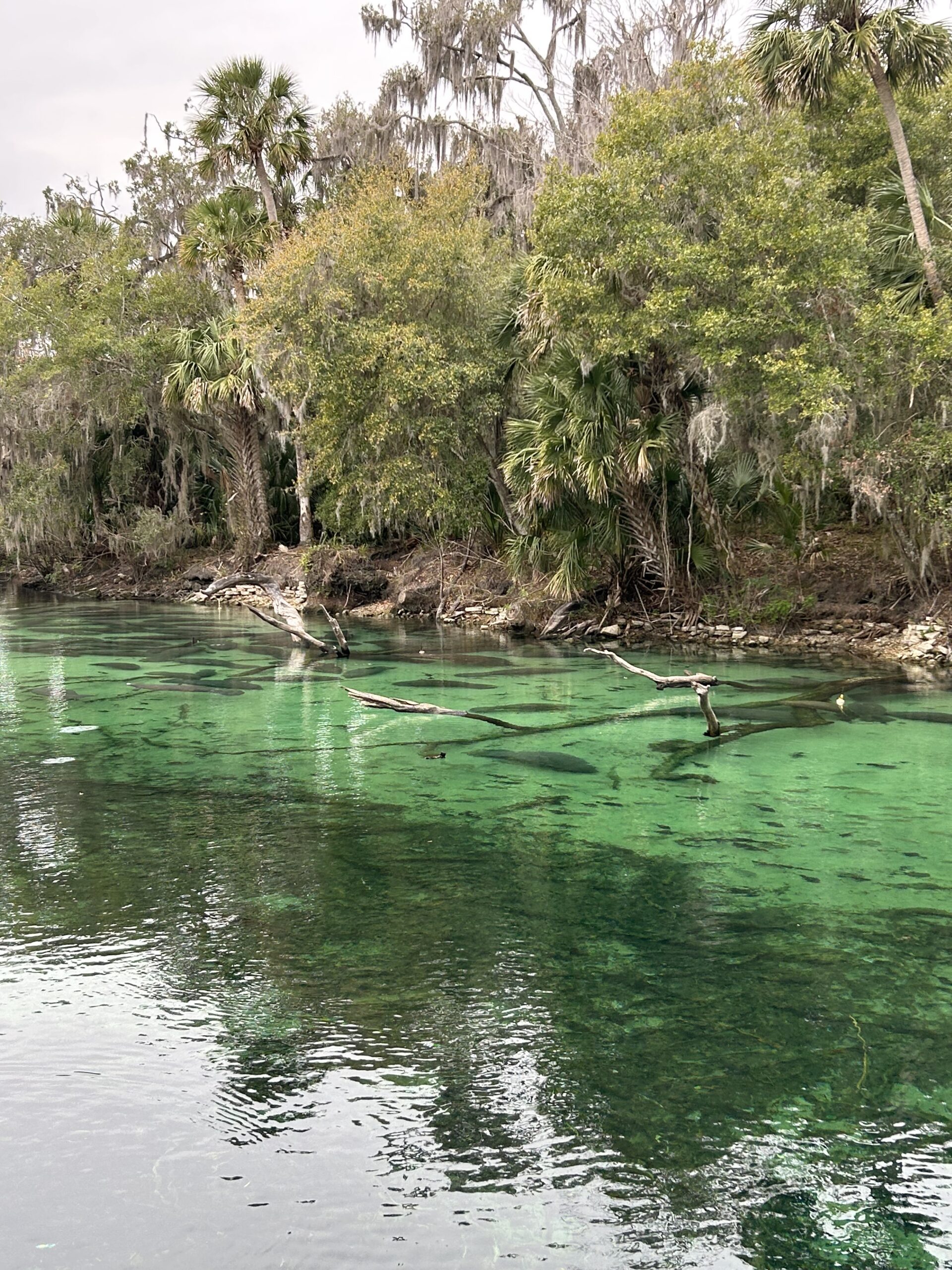
Seeing Florida’s manatees during their winter migration was at the top of my bucket list, and a few years ago, I traveled with my partner to see them in Blue Spring State Park. It was a day I will always remember! I will have the opportunity to work with the Panhandle Manatee Program to help them increase educational outreach on April 18 at the Earth Day Pensacola Festival.
The 2026 theme for the event is “Planet vs. Plastics”, and there will be eco-focused vendors, information booths and a children’s area. Manatees are a treasured symbol of Florida, and these unique marine animals rely on our protection to survive. For more information on how you can help, visit any of the linked websites in this article.
Emily Jordan is Escambia County’s Sea Turtle and Manatee Intern, representing the National Wildlife Federation. She is an undergraduate student of the University of West Florida, where she is pursuing her bachelor’s degree in environmental science and environmental management. She is dedicated to the long-term stewardship of Florida’s local ecosystems and plans to focus her professional efforts on the conservation and recovery of regional wildlife.
