










We have much more to do and your continued support is needed now more than ever.
Glowing in the Dark: The Secret UV Lightshow in Your Backyard

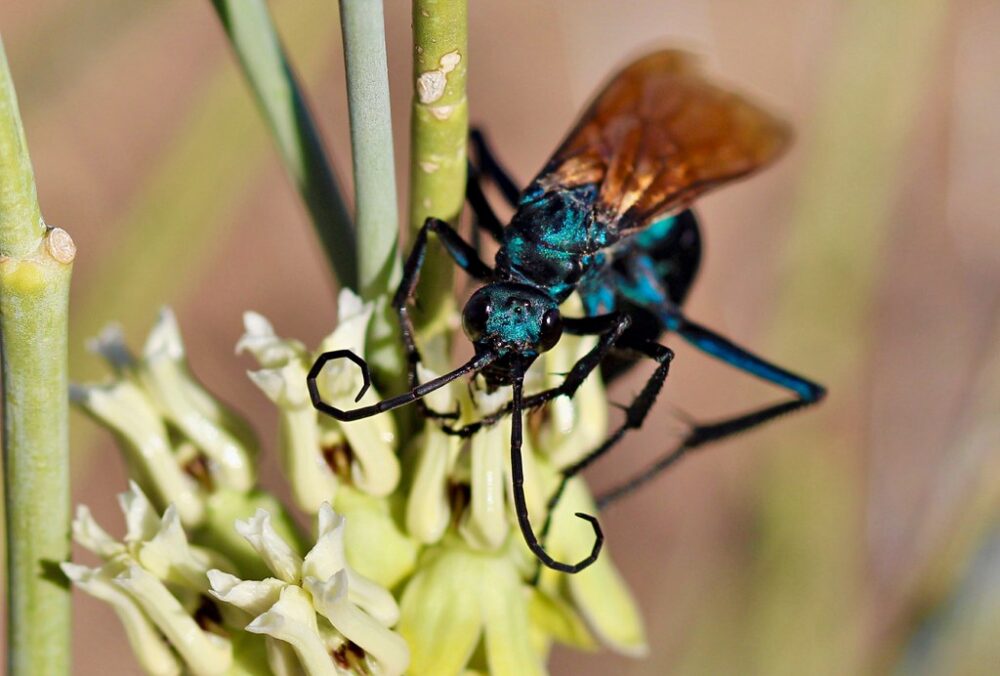
Credit: Sonorabee/Flickr
Somewhere outside your window right now, animals are glowing. You won’t see it without help, but shine an ultraviolet flashlight into your backyard on a warm night and you might find pink opossums, bright blue frogs, or green and yellow bats. This is biofluorescence: one of the least understood but surprisingly widespread phenomena of the animal kingdom. In fact, over 3,500 animal species have been confirmed to be biofluorescent!
What is Biofluorescence?
Biofluorescence is the ability to absorb short-wavelength light (ultraviolet or blue) and re-emit it as longer-wavelength, visible light. It is different from bioluminescence, which is when animals produce their own light chemically, the way fireflies or anglerfish do.
Biofluorescent animals need a light source, but once they do they can turn it into something completely different. A drab brown frog becomes electric teal. A porcupine’s quills change from white to blazing blue-green. A grizzled opossum can look like something straight out of a blacklight poster.
Why Do Biofluorescent Animals Glow?
Moths were the first animals scientists learned could glow, back in the early 1900s, but since then they have found the trait basically everywhere they look.
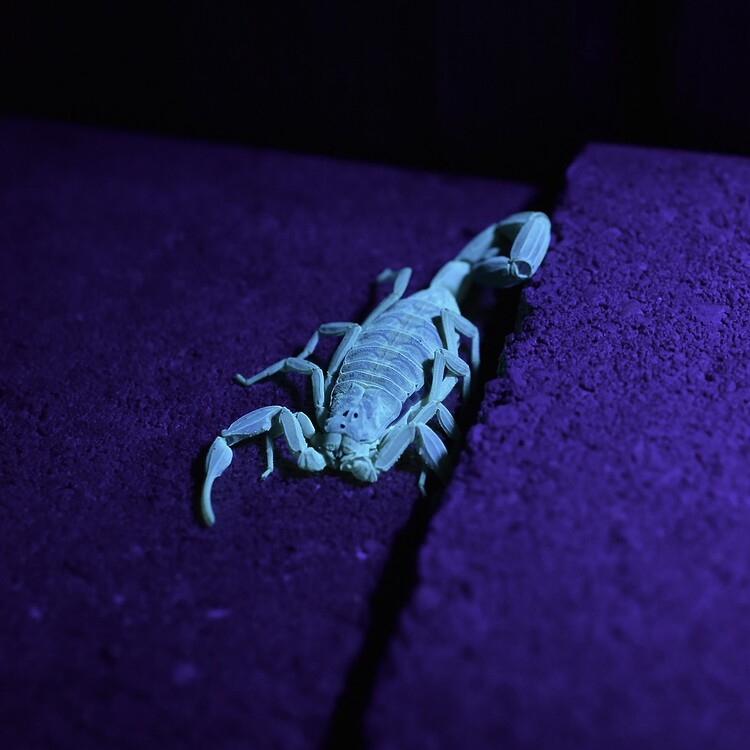
Every single amphibian species tested to date glows. All 2,500 known scorpion species glow. In a recent survey of 125 mammal and marsupial species, every single one showed some degree of fluorescence.
So what is all this glowing for? That’s where things get genuinely interesting, because for many species, we still have no idea.
Secret Communication
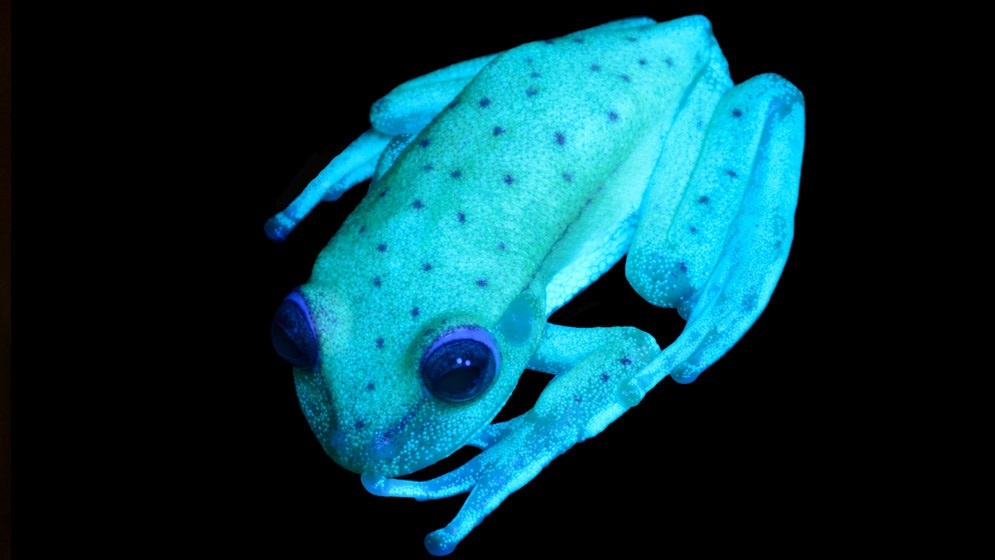
For some animals, the glow appears to serve a genuine purpose. The polka-dot tree frog’s glow, for example, accounts for about 30% of all light emanating from the animal (roughly 18% the brightness of a full moon). The wavelengths match almost exactly what frog eyes are most sensitive to. They even leave fluorescent residue on surfaces they touch. Taken together, it seems the light may be used to signal to their own kind.
Some birds show a significant preference for mates with intact fluorescent feathers over those with experimentally blocked. This is strong evidence that, at least for some species, fluorescence probably acts as a sexual signal.
The eastern tube-nosed fruit bat has distinctive vivid yellow-green fluorescent spots that appear to be unique to each individual, which would make sense as a mechanism for individual recognition in large colonies.
Although this species is Australian, we now know that at least six North American bat species glow under UV, including the big brown and Mexican free-tailed bats. Whether any of them use it for communication is still unknown.
Camouflage by Light
This might sound paradoxical until you realize that predators can often also see in UV— which means glowing in UV can help animals disappear into a glowing environment. Some of the strongest evidence comes from reef fish, which can use fluorescence to match the fluorescent colors of backdropped corals.
Research on reef communities has found that glowing species are often cryptic in other ways; for example pipefish with a body form that resembles aquatic grass. Glowing appears largely absent from conspicuous species like surgeonfish.

The tube-nosed fruit bat may use light for camouflage, too. Its UV-reactive wing spots could break up its outline against dried leaves during daytime roosting, helping to avoid UV-sensitive birds and snakes.
Warning Coloration
While some glowing may help an animal stay hidden, it may serve as a warning system for others. The North American porcupine’s quills glow blue-green und UV, which researchers believe make the white tips of their sharp quills even more vivid to predators. That’s in addition to a defense system that already includes high-contrast coloration and pungent gland-secretion. Fluorescence may simply be one more tool in the arsenal.
The Mystery of Mammalian Glow
For many of North America’s most familiar glowing animals, all of the above hypotheses remain speculative at best, and this is especially true for mammals and marsupials. Flying squirrels and opossums are pink, some bats are green, and no one can tell why.

The leading alternative to the above theories is much simpler: it might just be chemistry. All mammal and marsupial fur contain keratin, a protein that fluoresces naturally, and porphyrins—byproducts of making hemoglobin.
Porphyrins are strongly fluorescent and degrade in light, meaning nocturnal animals that aren’t exposed to the sun are able to retain them.
The emerging consensus is that fluorescence is meaningful in some species and incidental in others, and that untangling the two will keep researchers busy for a long time!
Ultraviolet Safari: Try it Yourself!
Many of our glowing species live right alongside us! Consider taking an evening to explore your area in a different light using these guidelines:
- Get a UV flashlight. Look for a 365nm UV flashlight for the best experience.
- Add a filter. Yellow-tinted UV safety glasses block reflected UV and make fluorescent emissions stand out dramatically.
- Time it right. Warm, dark, moonless nights are ideal.
- Navigate with red light. When you need to see your surroundings, use a red light rather than white. It preserves your night vision and minimizes disturbance to wildlife.
- Be considerate. Avoid shining the light directly into an animal’s eyes, and keep exposure time short for vertebrates especially.
Not sure what to look for in your region? Here’s a quick breakdown of which groups glow, and what color:

