



We have much more to do and your continued support is needed now more than ever.
Why Science and Storytelling Matter More Than Ever for Prescribed Fire

GFC’s Doug Claxton leading Chris Parker through ignition techniques. Credit: Katrina Koning
In today’s changing climate, prescribed fire is more than just a land management technique. It’s a lifeline for our forests, grasslands, and wildlife. But despite its benefits, prescribed fire continues to face misunderstanding, regulatory pressure, and shrinking social license. That’s why now, more than ever, science and data collection must stand at the forefront of fire ecology.
The stories behind the burn
Prescribed fire is proven to reduce wildfire risk, restore native ecosystems, and promote biodiversity. Yet, for many legislators and citizens, these benefits can feel distant or intangible, especially when media headlines often focus only on fire gone wrong. What’s missing from the conversation are clear, visual examples of fire done right—paired with the kind of long-term data that tells the full ecological story.
That’s where scientists, land managers, and everyday observers come in. When we collect consistent, honest, and repeatable data about what’s happening on the ground before and after fire, when we show what healthy fire looks like, we give decision-makers and communities the evidence they need to stay informed and supportive.
But data alone isn’t enough. Stories move people. Stories narrate what is happening between the data points and beyond what a statistical analysis can provide, as habitats are not static but rather ever changing. That’s why combining strong science with powerful visuals and personal connections is key. A single photo series can convey what charts and policy briefs can’t: resilience, rebirth, and success.
These pictures from a burn in Collier County, Florida, show the successful improvement of gopher tortoise habitat. If a park visitor were to see the project just one day after the burn, they may think the habitat was ruined. If another visitor saw this area at 60 days post-burn, they may think it was always like this and not realize fire’s beneficial impact to this habitat.
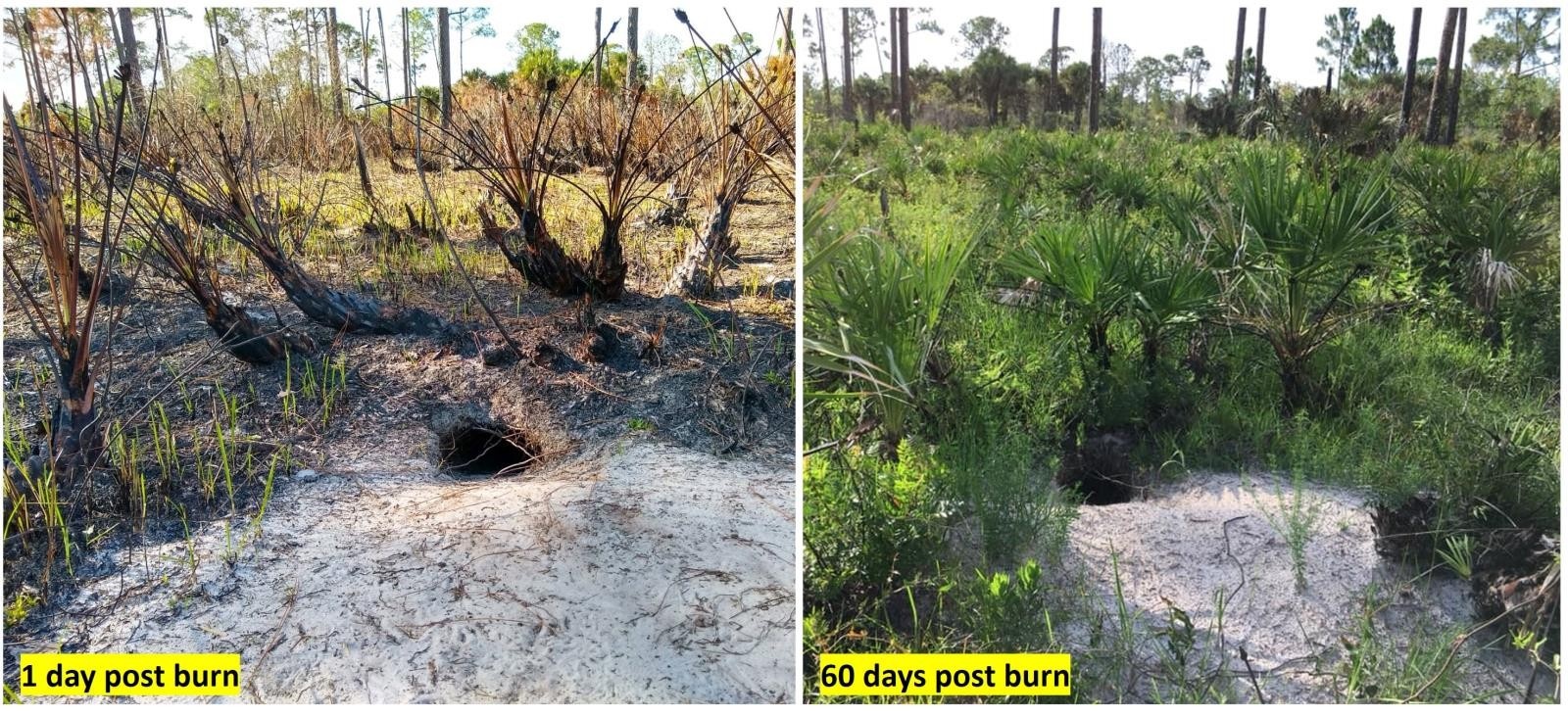
To help build this bridge between research and reality, The National Wildlife Federation’s Southeast Forestry team has created the Fire Ecology: Before & After Burn Observations project on iNaturalist. This public database invites landowners, burn practitioners, students, and scientists to share their before and after burn photos. By crowd-sourcing visuals across seasons, regions, and ecosystems, we can create a powerful, living archive of prescribed fire outcomes.
📸 You can view or contribute to the project here:
👉 Fire Ecology: Before & After Burn Observations
Whether you’re capturing a lush understory return, a bloom of fire-following wildflowers, or simply the slow recovery of a blackened landscape, your photos help tell the truth: prescribed fire works.
How to Contribute to the Fire Ecology Photo Project
Help us document how fire affects ecosystems by uploading Before and After Burn photos to our iNaturalist project.
✅ Step 1: Visit the Burn Site
- Choose 1-3 areas of interest within burn boundary (e.g., grassland, longleaf pine stand, wetland edge).
- Mark your photo points using GPS or a landmark.
✅ Step 2: Take Pre-Burn Photos
- Stand in the same direction for each point (use a compass or landmark).
- Take wide-angle photos to show vegetation structure.
✅ Step 3: Burn Happens
- Capture an image of active fire.
✅ Step 4: Take Post-Burn Photos
- Return to the same points after 1–60 days (multiple visits are encouraged!).
- Match the camera angle and distance as closely as possible.
✅ Step 5: Upload to iNaturalist
- Upload both pre and post images as separate observations.
- Add accurate date and location.
- Choose species seen (if visible) or just label as “habitat shot.”
- Add to our iNaturalist project and fill out the required fields.
We’re at a pivotal time in land management. The more we can document success, build trust, and make science visible, the better chance we have of protecting this essential tool—and the ecosystems that depend on it.
