







We have much more to do and your continued support is needed now more than ever.
Complex Challenges Require Multi-Faceted Solutions
Where we started…
In 1936 President Franklin D. Roosevelt called for federal, state, and local conservation and advocacy organizations across the United States to convene to address America’s degrading natural resources and declining wildlife populations. Organized by Jay Norwood “Ding” Darling, the North American Wildlife Conference served as the origin for the General Wildlife Federation, which in 1938 would become the National Wildlife Federation (NWF).

Collaboration is at the core…
As a true federation of conservation organizations, with 52 autonomous state and territory affiliate non-profit organizations, the National Wildlife Federation is the embodiment of collective conservation and environmental advocacy. Partnership and collaboration are at the core of our organizational DNA. From the beginning, NWF’s north star has been convening, coordinating, and collaborating with our partner networks, coalitions, and NWF affiliate organizations to address at scale, the environmental degradation facing our nation’s natural resources.
Now, as environmental challenges grow, more interdisciplinary and interconnected than ever, this structure has become increasingly important. Our role to help inform the work of our partners, coordinate the priorities of national and regional coalitions we help lead, and collaborate with our affiliates on shared work puts NWF in a unique position to facilitate landscape-scale outcomes.
With no one organization able to do it all, we all have a role to play in addressing the looming environmental challenges facing this country. Key to harnessing that collective power are the “bridge-builders”: organizations like NWF that serve as the mortar between bricks, the connective tissue that helps facilitate coordinated responses to complicated problems.
Amplifying important work…
One key role that national “bridge-building” organizations like NWF play is to amplify the important work of our partners. In doing so we shine a spotlight on innovative approaches, significant outcomes, and organizations whose work is not widely recognized. Perhaps most importantly, amplifying the work of our partners ensures that the successes and failures of work in one area inform new work elsewhere.
Utilizing our national platform to communicate the good work of our partners is particularly important when it comes to enhancing the resilience of our shorelines to coastal impacts. Building coastal resilience is at the nexus of complex and overlapping management jurisdictions, competing cross-sector interests, and a growing and increasingly diverse network of practitioners and interested parties.
NWF’s role in amplifying effective, innovative, and geographically transferrable approaches is incredibly important to address landscape-scale challenges.
One of the big issues…
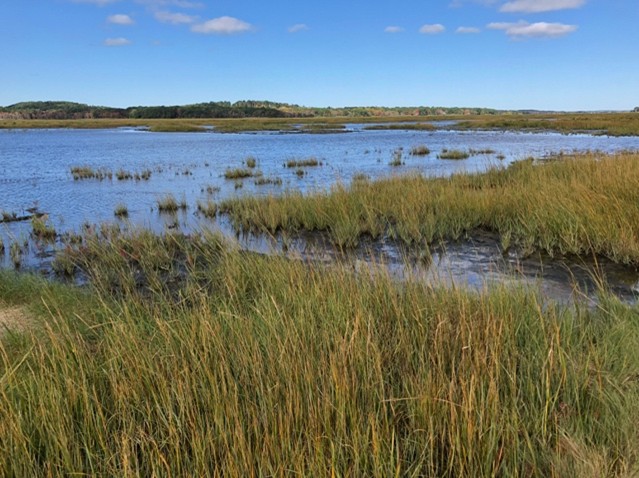
An example of a landscape-scale issue that increases the vulnerability of our coasts is reduced hydrologic functioning across our saltmarshes and estuaries. The ability for water to move in and out of these systems is fundamental to both maintaining healthy coastal habitats that sustain economically and ecologically important wildlife species, as well as reducing the impacts of flooding and erosion from coastal storms.
This is particularly true along the east coast where old agricultural practices and efforts to reduce mosquito populations have resulted in the creation of a network of deep ditches and embankments along the majority of saltmarsh habitat from Virginia to Maine.
The result is the natural flow of water through the system is disrupted, which can trap water for too long and lead to vegetation loss through drowning plants, and the eventual sinking of the marsh platform known as subsidence. In addition, storm-driven flooding is exacerbated when floodwater is trapped and slow to recede, which increases the impacts of flooding on coastal communities up and down the east coast.
Highlighting success…
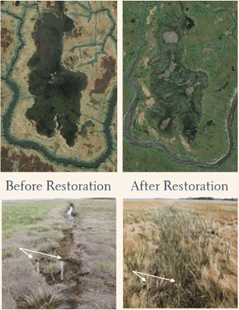
For NWF, part of addressing the broader issue of reduced hydrologic functioning includes amplifying effective approaches being implemented by our partners that, when replicated, would result in significant landscape-scale outcomes.
For example, NWF is amplifying important work in New Hampshire where two of our longtime partners, New Hampshire Audubon (our NH affiliate), and the University of New Hampshire’s Coastal Habitat Restoration Team are leading a demonstration project utilizing a strategy called Single Channel Hydrology to slow the conversion of marsh to standing water and build sediment in manmade ditches to restore the network of naturally-occurring tidal channels.
The approaches utilized in this project have demonstrated success at restoring marsh hydrology and reducing the conversion of marsh habitat to open water. In showcasing the efficacy of this work nationally, NWF is serving one of our longstanding roles—showcasing the effective work of our partners and affiliates for the purpose of connecting disparate activities in order to increase the efficiency and effectiveness of conservation investments at a landscape-scale.
